
REGULATORY & COMPLIANCE
How to Make a Golf Cart Street-Legal: Complete FMVSS 500 Checklist, 17-Digit VIN & Title Guide for US Operators
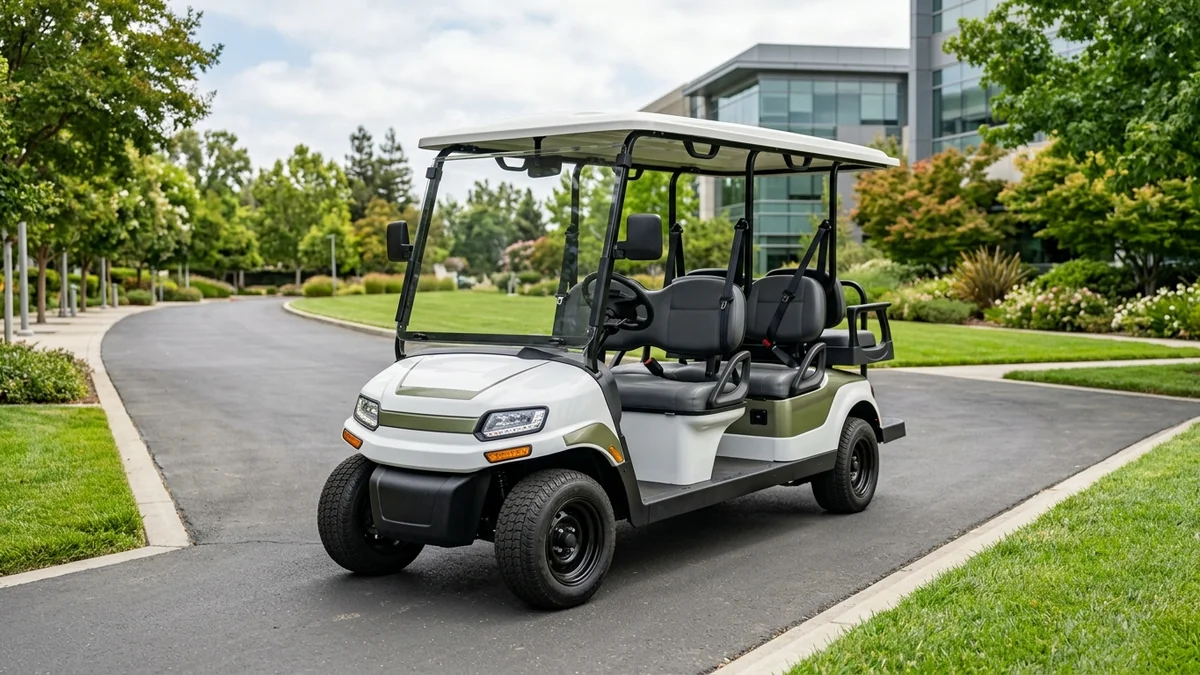
Commercial property managers, planned community operators, and resort fleet directors frequently require vehicles that can legally transition across public secondary streets connecting separated parcels of private property. However, operating an uncertified golf cart on public roads exposes organizations to severe commercial liability, immediate impoundment, and insurance policy nullification. Navigating the legal threshold requires strict alignment with US Federal Motor Vehicle Safety Standard 500 (FMVSS 500), factory-certified 17-digit VIN issuance, and state-level DMV title documentation.
The Federal Statutory Boundary: Golf Cart vs. Low-Speed Vehicle (LSV)
Under United States federal law, a traditional golf cart is legally classified as an off-road utility conveyance manufactured under ANSI Z130.1 guidelines, designed strictly for recreational golf fairways with an unalterable maximum governed speed under 15 mph (24 km/h). Because golf carts are not classified as motor vehicles, they lack federal safety certification.
In contrast, a Low-Speed Vehicle (LSV) is a legally recognized motor vehicle category established under National Highway Traffic Safety Administration (NHTSA) regulations codified in Title 49 of the Code of Federal Regulations, Part 571.500 (FMVSS 500). To qualify as an LSV, the vehicle must be electric or gas-powered, have 4 wheels, carry a Gross Vehicle Weight Rating (GVWR) under 3,000 lbs (1,361 kg), and feature a governed top speed between 20 mph (32 km/h) and 25 mph (40 km/h).
- Speed window: Must achieve at least 20 mph but cannot exceed 25 mph on paved level surfaces.
- Federal classification: Recognized under 49 CFR Part 571.500 as a certified motor vehicle eligible for public highway use.
- Roadway jurisdiction: Permitted to operate on secondary public roads with posted speed limits up to 35 mph (56 km/h).
Review foundational regulatory differences and vehicle specifications: Electric Low-Speed Vehicles (LSV) vs Golf Carts Guide, 4-Seat Street-Legal Electric Models
The 11 Mandatory Safety Equipment Requirements Under FMVSS 500
To attain federal street-legal status, an electric vehicle cannot simply add aftermarket mirrors. Federal standard FMVSS 500 mandates eleven specific, certified safety systems engineered into the vehicle platform:
- DOT-Certified Automotive Headlamps: High and low-beam illuminated headlamps meeting SAE J578 color and photometric distribution standards.
- Front and Rear Turn Signals: Steering-column-mounted directional signals with dashboard indicator lights and audible flashers.
- Tail Lamps and High-Mounted Stop Lamps: Red rear running lights and high-intensity brake lamps visible from at least 500 feet in daylight.
- Reflex Reflectors: Amber side reflectors on front quarter panels, red reflectors on rear fenders, and rear reflex lenses.
- Exterior Mirrors & Interior Mirror: Driver-side exterior mirror paired with either an interior panoramic rearview mirror or passenger exterior mirror.
- Parking Brake with Mechanical Interlock: Independent parking brake capable of holding the fully laden cart on a 20% incline.
- DOT AS-4 / AS-5 Laminated Safety Windshield: Automotive safety glass bearing permanent DOT manufacturer stamps (non-compliant acrylic folding screens fail inspection).
- Type 2 Three-Point Seat Belts (FMVSS 209/210): Retractable three-point lap-and-shoulder harnesses for all designated seating positions with reinforced chassis anchor points.
- Permanent 17-Digit Vehicle Identification Number (VIN): Federally registered VIN plate riveted to the structural chassis frame and driver door pillar.
- Audible Reverse Warning & Horn: Minimum 85 dB audible forward horn and automatic reverse motion warning beeper.
- Digital Speedometer & Odometer: Calibrated electronic dashboard display showing real-time road speed and cumulative vehicle mileage.
NHTSA Manufacturer Registration, 17-Digit VIN & Certificate of Origin (MCO)
The single most frequent barrier commercial buyers encounter when attempting to register imported low-speed carts is incomplete manufacturer documentation. To register an LSV at any US state Department of Motor Vehicles (DMV) or county tax collector office, the vehicle must possess an authentic 17-digit VIN structured in compliance with 49 CFR Part 565.
This requires the manufacturer to possess an active World Manufacturer Identifier (WMI) registered directly with NHTSA. Every Waygo street-legal vehicle is supplied with an official Manufacturer's Certificate of Origin (MCO / MSO) and EPA/DOT certification documentation confirming safety standards, allowing immediate title issuance, registration, and license plate assignment without costly third-party safety reconstructs.
| Regulatory & Mechanical Domain | Standard Commercial Golf Cart (ANSI Z130.1) | Factory-Certified Street-Legal LSV (FMVSS 500) | Commercial & DMV Title Consequence |
|---|---|---|---|
| Federal Vehicle Classification | Unregulated off-road utility cart | Federally certified Low-Speed Motor Vehicle | Eligible for DMV registration and standard highway license plates |
| Chassis Identification Plate | Proprietary 6–10 digit factory serial code | 17-Digit NHTSA-registered WMI / VIN plate | Satisfies state title registry and commercial fleet insurance underwriters |
| Governed Roadway Top Speed | 12 – 14 mph (19 – 23 km/h) | 20 – 25 mph (32 – 40 km/h) | Legally permitted to navigate roads posted up to 35 mph (56 km/h) |
| Windshield Material Standard | Fold-down clear acrylic or polycarbonate sheet | DOT AS-4 or AS-5 certified laminated safety glass | Resistant to wiper abrasion, stone impacts, and shattering hazards |
| Passenger Restraint Harnesses | Optional aftermarket 2-point lap belts | Type 2 3-point retractable shoulder harnesses | Ensures commercial occupational safety (OSHA) compliance |
| Permitted Operating Geography | Fairways, private resorts, cart paths only | Municipal roads, cross-property transit, campus avenues | Allows cross-campus transit without flatbed towing |
State-Level Operating Frameworks: California, Florida, Texas & Beyond
While FMVSS 500 sets baseline federal equipment specifications, individual state vehicle codes dictate where and how LSVs operate. In California (CVC 21250), Florida (FS 320.01), Texas (TC 551.301), and most jurisdictions, registered LSVs may operate on roads with posted speed limits up to 35 mph, provided the vehicle does not exceed its 25 mph governed limit.
Furthermore, operators must hold a valid driver's license, and commercial entities must carry state-mandated property damage and bodily injury liability insurance policies. Review state administrative codes prior to ordering multi-vehicle fleets.
Why Factory-Built Street-Legal Units Outperform Aftermarket Conversions
Many fleet operators attempt to retrofit conventional golf carts with aftermarket light kits and seat belts. In commercial practice, these conversions frequently fail state safety inspections because the vehicle chassis lacks reinforced seat belt anchorage pull-test ratings (FMVSS 210) and lacks an authentic NHTSA-assigned VIN.
Procuring factory-built Waygo street-legal vehicles guarantees that wiring harnesses are engineered for automotive currents, brakes meet dynamic stopping distance thresholds, and factory MCO documentation guarantees immediate DMV title approval on arrival.