
REGULATORY & COMPLIANCE
Electric Low-Speed Vehicles (LSV) vs. Golf Carts: Street-Legal Rules & Fleet Requirements
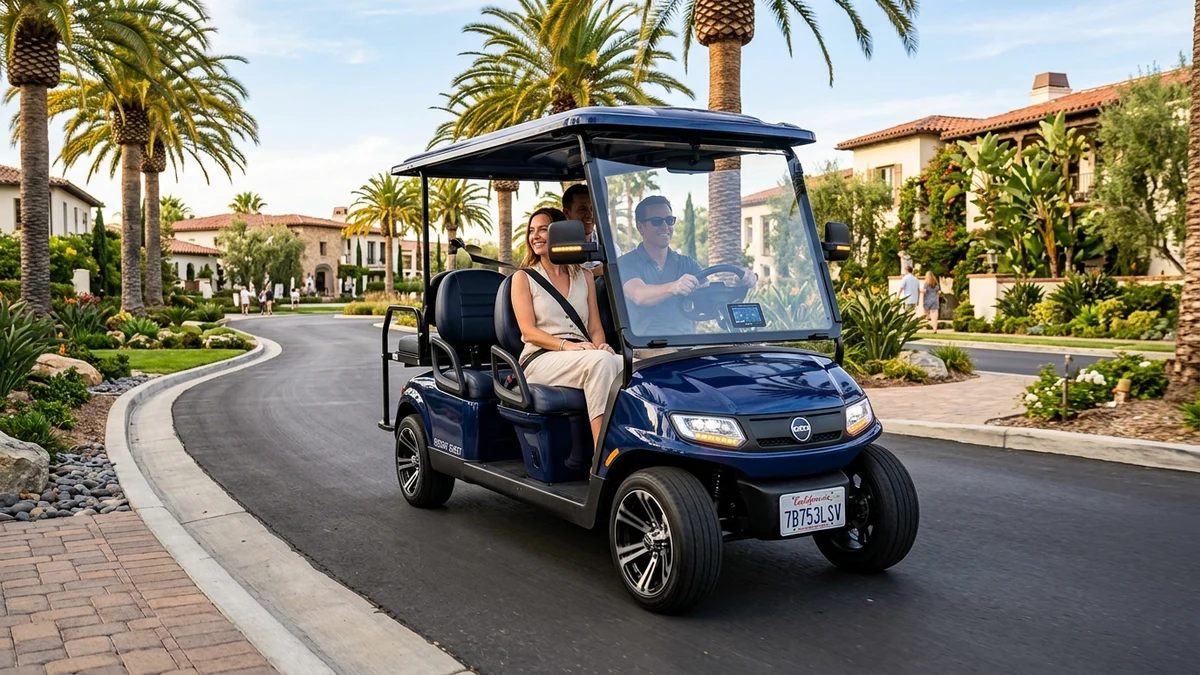
Across master-planned residential communities, corporate campuses, municipal parks, and beachfront resorts, fleet managers and dealerships frequently face a critical compliance decision: should they procure standard commercial electric golf carts or invest in certified Low-Speed Vehicles (LSVs)? While the two vehicle types may share similar silhouettes, their regulatory classifications, engineering requirements, top speed thresholds, and street-legal operating boundaries are fundamentally distinct. Operating a traditional golf cart on a public road where an LSV is legally mandated exposes commercial operators to severe liability, traffic citations, and insurance nullification. In this engineering and regulatory guide, Waygo breaks down the exact legal distinctions under Federal Motor Vehicle Safety Standard 500 (FMVSS 500), details the required safety equipment checklist, and provides an operational decision matrix to help you configure the right fleet for your property.
The Legal & Engineering Distinction: What Defines an LSV?
In the United States, golf carts and Low-Speed Vehicles (LSVs) are governed by entirely different federal and state legal frameworks. Under standard definitions established by the National Golf Car Manufacturers Association (NGCMA) and ANSI standard Z130.1, a traditional golf cart is designed primarily for off-road operation on golf courses and closed private properties, with a maximum governed top speed strictly under 20 mph (typically 12–15 mph).
Conversely, a Low-Speed Vehicle (LSV) is a federally recognized motor vehicle classification codified under Title 49 of the Code of Federal Regulations (CFR), Part 571.500 (Federal Motor Vehicle Safety Standard 500, or FMVSS 500). By federal mandate, an electric low speed vehicle must achieve a minimum speed of 20 mph and a maximum speed of 25 mph on a paved level surface. Because LSVs are certified to travel on public secondary roadways with posted speed limits of 35 mph or lower in most states, they are subject to rigorous automotive safety equipment, braking distance, and manufacturing certification mandates.
| Regulatory & Mechanical Metric | Standard Commercial Golf Cart | Certified Electric Low-Speed Vehicle (LSV) |
|---|---|---|
| Governing Standard | ANSI / NGCMA Z130.1 (Voluntary Industry Standard) | NHTSA FMVSS 500 (Federal Motor Vehicle Safety Standard) |
| Governed Top Speed | Under 20 mph (typically calibrated to 12–15 mph) | 20 mph to 25 mph (mandated governed operating window) |
| Legal Roadway Access | Private grounds, closed golf courses, and designated crossings only | Public secondary roads with posted speed limits ≤ 35 mph (varies by state) |
| Vehicle Identification | Factory serial number or chassis production stamp | Federally registered 17-digit ISO Vehicle Identification Number (VIN) |
| Registration & Titling | Generally not titled or registered with state DMV | State DMV registration, license plate, and road insurance required |
| Operator Licensing | Facility-determined rules (often 16+ or valid ID) | Valid state driver's license required for public street operation |
The FMVSS 500 Mandatory Street-Legal Equipment Checklist
The defining characteristic of an electric low speed vehicle is its integrated automotive-grade safety architecture. While many consumer golf carts can be retrofitted with aftermarket light bars, federal law mandates that a true street-legal LSV must be manufactured with specific safety hardware installed and tested at the factory level.
For dealership inventory and commercial fleets planning public street travel, our engineering team highlights the ten mandatory FMVSS 500 equipment items required before a vehicle can receive street-legal designation:
- High-output automotive headlights: Forward illumination with integrated high and low beams positioned to illuminate roadways without blinding oncoming drivers.
- Front and rear turn signals: Amber front and red/amber rear directional indicators with an audible flasher relay or dashboard indicator.
- Taillights, brake lights, and reflex reflectors: Red rear running lights, bright active stop lights, and red reflex reflectors on both sides and the rear perimeter.
- Dual exterior mirrors and interior rearview mirror: An exterior driver-side mirror paired with either an exterior passenger mirror or an interior wide-angle rearview mirror.
- DOT-approved windshield: AS4 or AS5 certified automotive laminated safety glass or shatterproof acrylic windshield.
- Electric windshield wiper: A dedicated motorized wiper mechanism covering the primary driver visibility sweep.
- Three-point DOT seat belts: Type 2 lap-and-shoulder seat belt assemblies installed at every designated passenger seating position.
- Emergency parking brake: Mechanical or electronic parking brake capable of holding the gross vehicle weight on a 20% incline.
- 17-Digit Vehicle Identification Number (VIN): Permanently stamped onto the primary structural chassis frame.
- Audible horn and backup alert: Forward sounding warning horn and audible reverse motion alarm for pedestrian safety.
Review Waygo vehicle specifications and custom options: Wholesale electric golf cart program, OEM custom safety packages and branding, Commercial fleet applications
Fleet Sizing Matrix: Closed Campus vs. Mixed-Traffic Operation
Choosing between a standard commercial golf cart and an LSV package requires an honest audit of your property layout and public roadway interaction. Over-specifying an LSV package for a completely private golf course adds unnecessary compliance and licensing expense. Conversely, deploying standard golf carts in a mixed-use community where drivers must traverse public avenues invites municipal citations and legal exposure.
Review our operational decision matrix to determine which classification fits your specific fleet application:
| Operating Environment | Typical Vehicle Classification | Key Operational Rationale |
|---|---|---|
| Private Golf Clubs & Country Clubs | Standard Commercial Golf Cart | Self-contained turf and path network; speeds capped at 15 mph protect course turf and player safety. |
| Master-Planned Residential Communities | Electric Low-Speed Vehicle (LSV) | Residents and staff regularly transit public residential streets to reach clubhouses, pools, and retail centers. |
| Luxury Beach & Island Resorts | Electric Low-Speed Vehicle (LSV) | Connecting detached villa compounds, private marinas, and beachfront dining along public coastal roads. |
| Corporate & University Campuses | Mixed Commercial Fleet | Standard utility carts for central pedestrian plazas; LSV-equipped shuttles for crossing municipal city streets. |
| Municipal Parks & Waterfront Districts | Electric Low-Speed Vehicle (LSV) | Maintenance and patrol staff must share roads with automotive traffic and public municipal transit. |
Custom LSV Compliance Packages: Factory Direct Configuration
At Waygo, we manufacture commercial 2-seat, 4-seat, and 6-seat passenger models engineered from the chassis up for both campus and street-legal applications. Through our OEM customization studio, wholesale buyers and dealers can order production-line integration of DOT-certified laminated glass windshields, automotive wiper motors, three-point seat belts, and full LED optical lighting systems.
Each vehicle is equipped with a high-efficiency 5 kW AC powertrain and automotive-grade 51.2V LiFePO4 lithium batteries, delivering the immediate torque and dependable 25 mph cruising speed demanded by US commercial road conditions. Our Sacramento, California commercial depot assists volume dealers with technical documentation, compliance coordination, and rapid-dispatch replacement safety components.
Explore our commercial vehicle range or request an LSV quote: Commercial electric golf carts for sale, 2-seat commercial fleet models, 4-seat commercial fleet models, 6-seat commercial fleet shuttles, Request a commercial quotation