
CHASSIS ENGINEERING
Golf Cart Chassis Engineering: Hot-Dip Galvanized, Aluminum & Coated Steel Frames in Coastal & High-Humidity Fleets
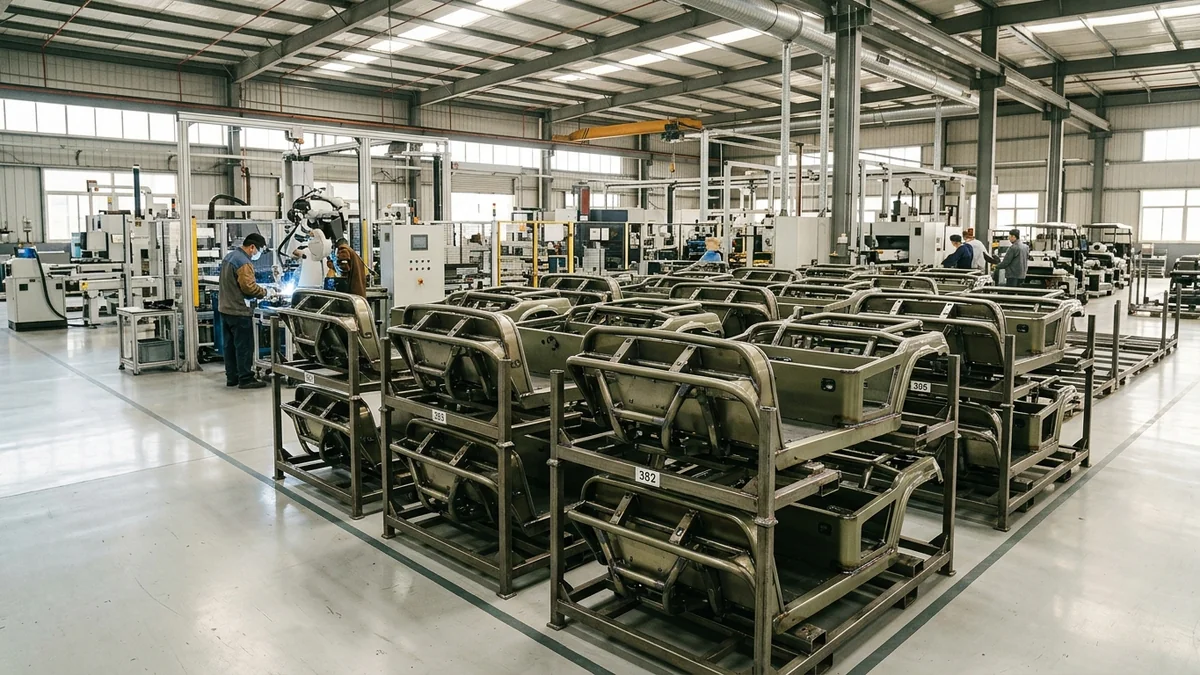
In coastal resorts, island transport operations, and golf courses utilizing recycled water or chemical turf fertilizers, chassis frame corrosion is the leading cause of premature fleet retirement. While battery packs, motor controllers, and seating upholstery can be refurbished or swapped in the field, structural chassis perforation compromises passenger safety, distorts suspension geometry, and renders vehicles unroadworthy. Understanding the metallurgy, protective coating chemistry, and torsional rigidity of commercial chassis options ensures durable asset preservation.
The Coastal Corrosion Trap: Airborne Chlorides and Chemical Fertilizer Degradation
Operating a commercial electric cart within 5 miles of an ocean shoreline exposes metal sub-structures to continuous airborne marine aerosols rich in sodium chloride (NaCl) and magnesium chloride (MgCl2). When microscopic salt fog settles on metal frame rails, it forms an aggressive electrolyte solution that accelerates galvanic oxidation.
In golf course and resort operations, this environmental stress is compounded by turf maintenance practices. Nitrogen-, phosphorus-, and potassium-rich synthetic fertilizers, along with high-salinity effluent irrigation water, are thrown directly against lower chassis rails by rotating turf tires. Standard painted steel tubular frames frequently experience hidden internal rusting, where moisture condenses within hollow box sections, quietly destroying structural integrity from the inside out.
- Internal box section rust: Condensation traps moisture inside ungalvanized hollow tubes, causing structural frame failure before surface blemishes become visible.
- Dissimilar metal galvanic corrosion: Fasteners, suspension brackets, and battery hold-downs create galvanic couples that accelerate localized metal pitting.
- High-pressure wash degradation: Daily pressure-washing forces saline grit and degreasers through microscopic cracks in standard lacquer or powder coatings.
Review Waygo vehicle customization and chassis options: Authorized U.S. dealer network, Commercial Utility Cargo Carts Guide
Structural Material Options: Q235B Carbon Steel vs. 6061-T6 Aircraft Aluminum
Commercial fleet manufacturers primarily utilize two foundational metals for structural vehicle undercarriages: high-strength structural carbon steel (such as Q235B or cold-rolled rectangular tubing) and aerospace-grade extruded 6061-T6 aluminum alloy.
Carbon steel delivers exceptional mechanical strength and an Elastic Modulus of approximately 210 GPa, providing rigid resistance against chassis flexing when carrying heavy 6-passenger loads over curbs or uneven fairway dips. However, bare carbon steel has zero inherent resistance to oxidation and depends entirely on surface protective coatings to survive.
Conversely, extruded 6061-T6 aluminum provides native chemical rust immunity. When exposed to oxygen, aluminum naturally forms a tough microscopic passivated aluminum oxide (Al2O3) skin that permanently blocks further corrosion. However, aluminum has an Elastic Modulus of roughly 69 GPa—only one-third that of steel. To achieve equivalent structural rigidity without excessive chassis flexing under commercial loads, aluminum frames require significantly thicker tubular wall sections and reinforcement gussets.
Surface Chemistry: Cathodic E-Coat vs. Hot-Dip Galvanizing in Salt Spray Testing
When structural carbon steel is selected for maximum load capacity, the coating chemistry dictates vehicle longevity. The international benchmark for measuring anti-corrosion efficacy is the ASTM B117 salt spray chamber test, which exposes coated components to continuous 5% saline fog at 35°C (95°F).
Standard electrostatic powder coating provides adequate barrier protection on flat outer surfaces, but often exhibits thin coverage on sharp cut edges and fails to penetrate interior tube cavities, typically showing blistering within 250 to 350 test hours.
Cathodic Electrophoretic Deposition (E-Coat) submerges the entire welded chassis into a charged waterborne epoxy primer bath. The electrical charge draws primer into every interior void, providing uniform 20–25 μm coverage that endures 500 to 750 hours of ASTM B117 salt spray exposure.
The gold standard for harsh marine environments is Hot-Dip Galvanizing. The completed chassis is submerged in molten zinc at 450°C (842°F). The metallurgical reaction creates multi-layered zinc-iron alloys topped with pure zinc (75–95 μm thickness) bonded inside and outside all tubular sections. Even if scratched down to bare steel in commercial service, the surrounding zinc sacrifices itself galvanically to protect the underlying iron, surviving 1,200 to 1,500+ hours in ASTM B117 chambers without red rust.
| Chassis Construction / Coating System | Coating Chemistry & Process | ASTM B117 Salt Fog Rating | Structural Elastic Modulus | Estimated Coastal Lifespan |
|---|---|---|---|---|
| Standard Powder-Coated Mild Steel | 40 – 60 μm electrostatic polyester spray | 240 – 360 hours before blister failure | 210 GPa (Maximum load rigidity) | 2 – 3 years in beach / island properties |
| Cathodic E-Coat (Electrophoretic Dip) | 20 – 25 μm epoxy-based electro-deposition | 500 – 750 hours salt chamber exposure | 210 GPa (Excellent cornering stability) | 4 – 6 years in moderate marine air |
| Hot-Dip Galvanized Tubular Steel | 75 – 95 μm metallurgical zinc alloy layer | 1,200 – 1,500+ hours without rust breakdown | 210 GPa (Heavy-duty cargo rated) | 8 – 12+ years in extreme tropical / coastal zones |
| Welded 6061-T6 Aluminum Alloy | Natural passivated oxide + clear anodize | 1,500+ hours (Impervious to rust) | 69 GPa (Requires reinforced gussets) | 10 – 15+ years (Complete rust immunity) |
Balancing Torsional Rigidity, Curb Weight and Payload Capacity
Chassis engineering is not purely about corrosion; it directly governs ride quality, alignment stability, and steering precision. When a 6-seat shuttle traverses uneven speed humps or diagonal cart paths with 1,200 lbs of passenger payload, chassis torsion causes door latch misalignment, steering rack binding, and squeaking interior roof struts.
Waygo utilizes robotic continuous MIG welding on heavy-gauge structural tubular sections to maximize torsional stiffness while optimizing curb weight. When paired with high-energy LiFePO4 lithium batteries, the combined vehicle weight remains 350 kg lighter than traditional lead-acid carts, substantially reducing ground pressure on sensitive resort turf while ensuring structural durability.
Procurement Matrix: Specifying Chassis Protection in Commercial RFQs
When preparing a commercial fleet RFQ, buyers should match the chassis specification directly to property proximity to salt water and application harshness:
For inland golf courses and corporate campuses beyond 15 miles from coastlines, full cathodic E-coated structural steel provides ideal cost-efficiency and load strength. For beachfront hotels, island ferries, oceanview golf links, and heavy chemical utility service, hot-dip galvanized steel or 6061-T6 aluminum frames protect operational investments from premature write-downs.