POWERTRAIN ENGINEERING
AC vs. DC Motor in Commercial Golf Carts: Torque Efficiency, Gradeability & 5-Year Maintenance Costs
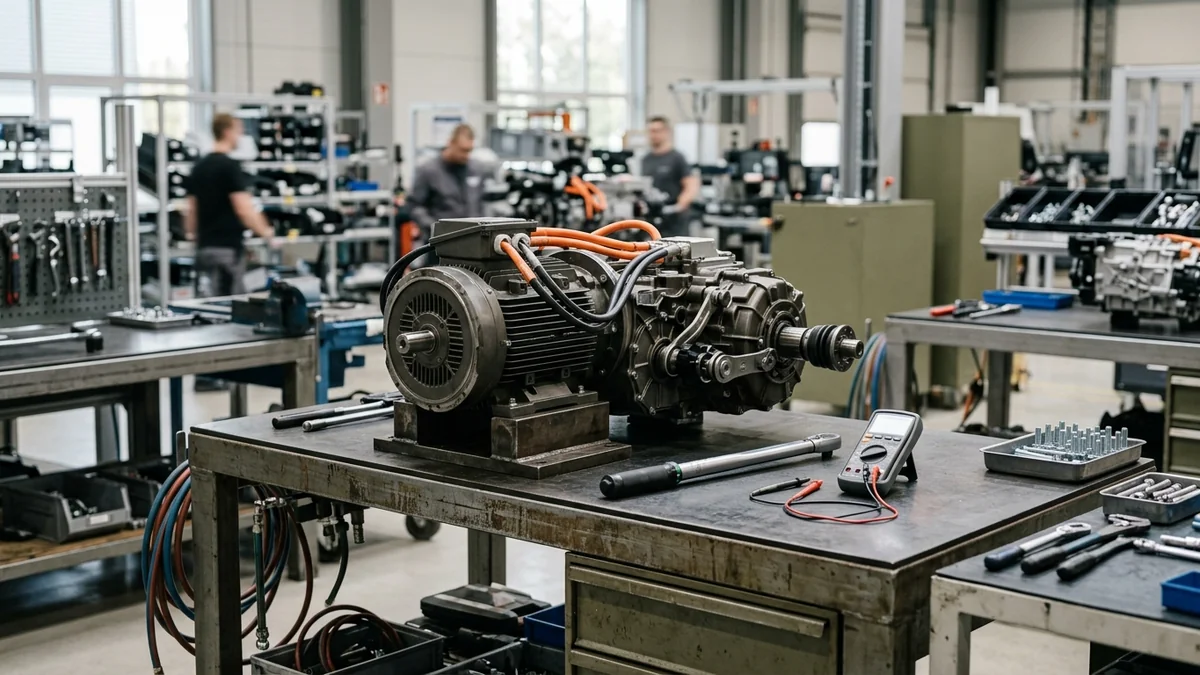
Selecting between alternating current (AC) and direct current (DC) motors determines how an electric golf cart fleet handles steep terrain, full passenger payloads, all-day multi-shift runtimes, and long-term maintenance overhead. While legacy DC powertrains remain common in budget recreational carts, professional commercial fleets require the sustained torque efficiency, sealed enclosure protection, and electronic control of brushless AC induction systems.
Low-End Torque Delivery and Steep Grade Climbing (25%–30% Slopes)
The mechanical demands of commercial golf cart operations differ substantially from casual fairway cruising. In multi-passenger resort shuttles, guest transit vehicles, and cargo haulers, electric powertrains must overcome severe static friction and initiate forward momentum on steep incline ramps under full gross vehicle weight ratings (GVWR).
Legacy DC series or shunt-wound motors generate peak torque only as rotational speed increases, requiring high inrush current from the battery bank that induces substantial resistive heat. In contrast, an integrated Waygo 4-seat commercial electric golf cart or 6-seat passenger shuttle powered by a 5.0 kW AC induction motor delivers maximum rated torque (up to 95 Nm at the motor shaft) almost instantaneously from 0 to 1,800 RPM. This flat low-end torque plateau empowers vehicles to comfortably climb 25% to 30% grades with full passenger occupancy without lurching, stalling, or tripping controller over-current alarms.
- Instantaneous low-end torque: AC induction motors deliver peak torque from zero rotational speed, eliminating stutter on steep resort inclines.
- Closed-loop digital feedback: High-resolution pulse encoders report rotor position to the motor controller in milliseconds, maintaining programmed speed on varying grades.
- Electronic Hill-Hold functionality: Advanced AC controllers automatically prevent roll-back on steep slopes when the accelerator pedal is released, enhancing guest safety.
Review vehicle specifications and commercial purchasing options: 4-Seat Commercial Electric Golf Carts, 6-Seat Commercial Passenger Shuttles, Commercial Fleet Applications
Thermal Management, Brushless Architecture & Multi-Shift Duty Cycles
Thermal degradation is the leading operational vulnerability of brushed DC motors. Traditional DC motors rely on spring-loaded carbon brushes pressing against a segmented copper commutator to alternate current direction. Under high mechanical load, this sliding mechanical contact creates severe friction, electrical arcing, and localized temperatures exceeding 130°C (266°F). To dissipate this internal heat, DC motor enclosures require open ventilation slots, leaving sensitive internal windings exposed to moisture, coastal salt air, silica sand, and abrasive turf dust.
Brushless AC induction motors eliminate mechanical commutators entirely. Magnetic fields are generated through stationary stator windings that induce rotational magnetic forces directly in a solid laminated rotor. Because primary heat is generated on the external stator housing rather than deep within a rotating armature, Waygo AC motors feature hermetically sealed IP66 to IP67 aluminum casings with heavy external cooling fins. Commercial carts can run back-to-back 8-hour shift cycles in 40°C (104°F) ambient temperatures without triggering thermal derating.
Regenerative Braking Physics & Mechanical Brake Conservation
Descending long steep grades with a full 6-passenger load places extreme stress on mechanical friction brakes. On traditional DC golf carts, drivers must ride the mechanical drum or disc brakes continuously, inducing rapid thermal pad fade, glazed friction linings, and frequent cable adjustments.
Waygo AC powertrain systems use electronic regenerative braking. When the operator eases off the accelerator or touches the brake pedal, the AC controller shifts the phase angle of the stator field, converting the motor into an electrical generator. Kinetic energy from the descending cart is converted back into electrical power, recharging the onboard 48V / 51.2V LiFePO4 lithium battery pack with 8% to 12% recovered range.
Simultaneously, the motor delivers smooth, controlled deceleration without mechanical wear. Service intervals for hydraulic brake pads and drums double from 12 months to 24–36 months, dramatically reducing scheduled shop downtime and commercial liability risk.
| Engineering Metric / Operating Condition | 48V Series / Shunt DC Motor (3.3 kW) | 48V / 51.2V AC Induction Motor (5.0 kW) | Commercial Fleet Impact |
|---|---|---|---|
| Peak Powertrain Efficiency | 78% – 82% across narrow RPM range | 90% – 94% across broad operational band | +12% to +15% extended daily runtime per battery charge cycle |
| Max Gradeability (4 Passengers) | 15% – 18% slope before thermal cut-off | 25% – 30% sustained grade climbing | Handles hilly fairways and ramp inclines |
| Motor Mechanical Design | Brushed commutator with sacrificial carbon shoes | Brushless induction rotor with digital encoder | Zero brush inspections, zero commutator turning, zero carbon dust |
| Enclosure Ingress Protection | IP20 – IP44 (Vented openings required) | IP66 – IP67 (Fully sealed housing with cooling fins) | Impervious to coastal marine fog, torrential rain, and pressure washing |
| Downhill Speed Regulation | Heavy mechanical friction brake reliance | Closed-loop regenerative electronic braking | Recovers 8%–12% battery energy while eliminating downhill brake fade |
| 5-Year Scheduled Maintenance | – per vehicle (brushes, resurfacing) | zsh per vehicle (Sealed bearing checks only) | Reduces routine technician service hours by over 80% |
5-Year Total Cost of Ownership & Fleet Maintenance Variance
While DC-powered utility carts often carry a slightly lower initial purchase price, their operational balance sheet rapidly erodes in commercial settings. Over a 5-year operating horizon, a 20-vehicle fleet utilizing DC motors accumulates hundreds of maintenance hours dedicated to inspecting brush wear, cleaning conductive carbon dust from motor windings, replacing glazed brake shoes, and repairing overheated motor controllers.
When calculating total commercial return on investment (ROI), the combined savings from reduced mechanic labor, extended brake component life, 12% lower utility charging costs due to higher electrical efficiency, and zero brush replacements deliver a net operating expenditure savings of over ,400 per vehicle across five years.
Review related charging and energy ROI guides: Electric Golf Cart Range & Charging Track Data, Lithium vs Lead-Acid 10-Year TCO Breakdown
Commercial Selection Framework: Matching Powertrains to Site Topography
For high-volume fleet operators, equipment specification should always mirror real-world terrain challenges. Flat, slow-speed private communities may operate satisfactorily on standard configurations, but multi-passenger resort operations, coastal hotel transit, and hilly campus routes strictly mandate 5.0 kW AC powertrains paired with automotive-grade CAN-bus controllers.
Consult with Waygo powertrain engineers during the preliminary configuration phase to model your route profile, elevation changes, and passenger duty cycles before finalizing production orders.