
OPERATING REQUIREMENTS
Electric Golf Cart Range & Charging: Real-World 48V LiFePO4 Track Data & Fleet Grid Sizing
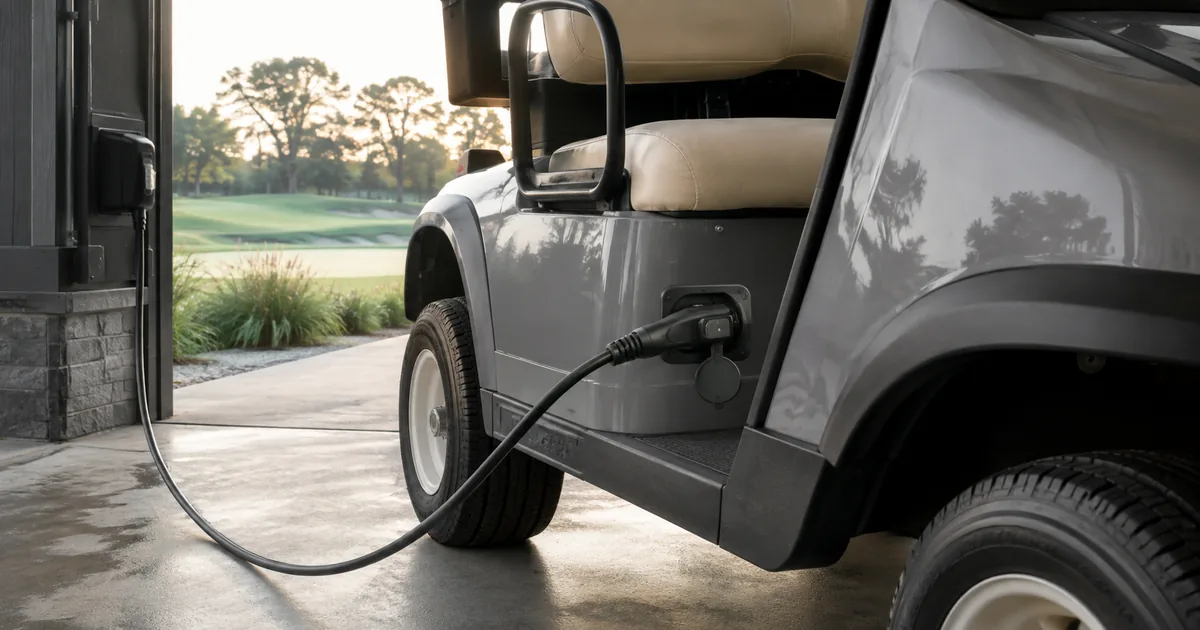
Electric golf cart range changes with passenger load, route grade, surface, stops, battery capacity and operating temperature. Waygo uses the published test figure as a model reference, then configures the battery and charging plan around the actual route.
Read the test condition behind the range figure
The current Waygo 4-seat reference configuration states 90 to 110 km of continuation range on a flat road with a 51.2V 150Ah LiFePO4 battery. That is a model-specific reference under the stated condition. It is not a promise that every 2-seat, 4-seat or 6-seat configuration will cover the same distance in service.
A resort cart carrying four adults and luggage on repeated climbs uses energy differently from a lightly loaded cart on smooth level paths. Waygo reviews the longest shift, actual passenger and cargo load and a practical operating reserve. Our applications overview separates the main route types.
Waygo commercial applications: Commercial fleet applications
What changes real-world range
Waygo battery recommendations use the following operating conditions:
- Daily mileage requirement: total cumulative miles each cart must travel per operating shift.
- Passenger and cargo payload: average versus maximum load (passengers plus luggage, tools, or supplies).
- Topography and grades: average terrain, maximum climb and repeated uphill sections. The current 4-seat reference lists 30 percent climbing capacity.
- Operating surface: paved roads versus soft turf, sand, gravel, or unpaved trail resistance.
- Driving dynamics: high stop-and-go frequency versus continuous long-distance cruising.
- Climate and storage: expected temperature range and whether carts are stored indoors or outside.
- Accessory load: lighting, display, audio, heaters or other electrical equipment.
Match charge time to the operating schedule
Our current 4-seat reference pairs a 48V 25A smart onboard charger with the 51.2V 150Ah battery and states a charge time under 8 hours at 80 percent discharge. This is an overnight-charge reference for that configuration. The actual result depends on starting state of charge, battery size, charger output, input power and temperature.
A larger battery can support a longer route and may need more charging time or a different charger. For two-shift operation, Waygo can assess a larger pack, a charging break or an additional vehicle. A qualified electrician must confirm circuit capacity and outlets for the number of chargers operating together.
| Item | What to record | Why it matters |
|---|---|---|
| Daily route | Distance per shift plus reserve | Sets the usable energy target |
| Battery | Chemistry, voltage and amp-hour capacity | Allows like-for-like comparison |
| Charger | Output, input voltage, plug and onboard or off-board design | Determines site compatibility and charging time |
| Charge window | Hours available and number of carts charging together | Determines fleet cover and electrical load |
Waygo electric golf cart models: 2-seat electric golf carts, 4-seat electric golf carts, 6-seat electric golf carts
Put the duty cycle in the RFQ
Waygo uses the daily distance, longest uninterrupted route, grade, surface, load, operating temperature and available charging hours in the RFQ. Our proposal identifies the battery, charger and the condition used for the stated range.
Waygo configurations can use a higher-capacity battery where the model allows. Cost, weight, available space and charge time change with the pack. The quote request form provides the operating data needed to match the proposed configuration to the route.
Waygo technical RFQ information: Wholesale RFQ checklist, Request a technical consultation