
FLEET ECONOMICS & TCO
Commercial Fleet TCO Breakdown: 4-Seat vs. 6-Seat Electric Shuttles for Resorts, Campuses & Venues
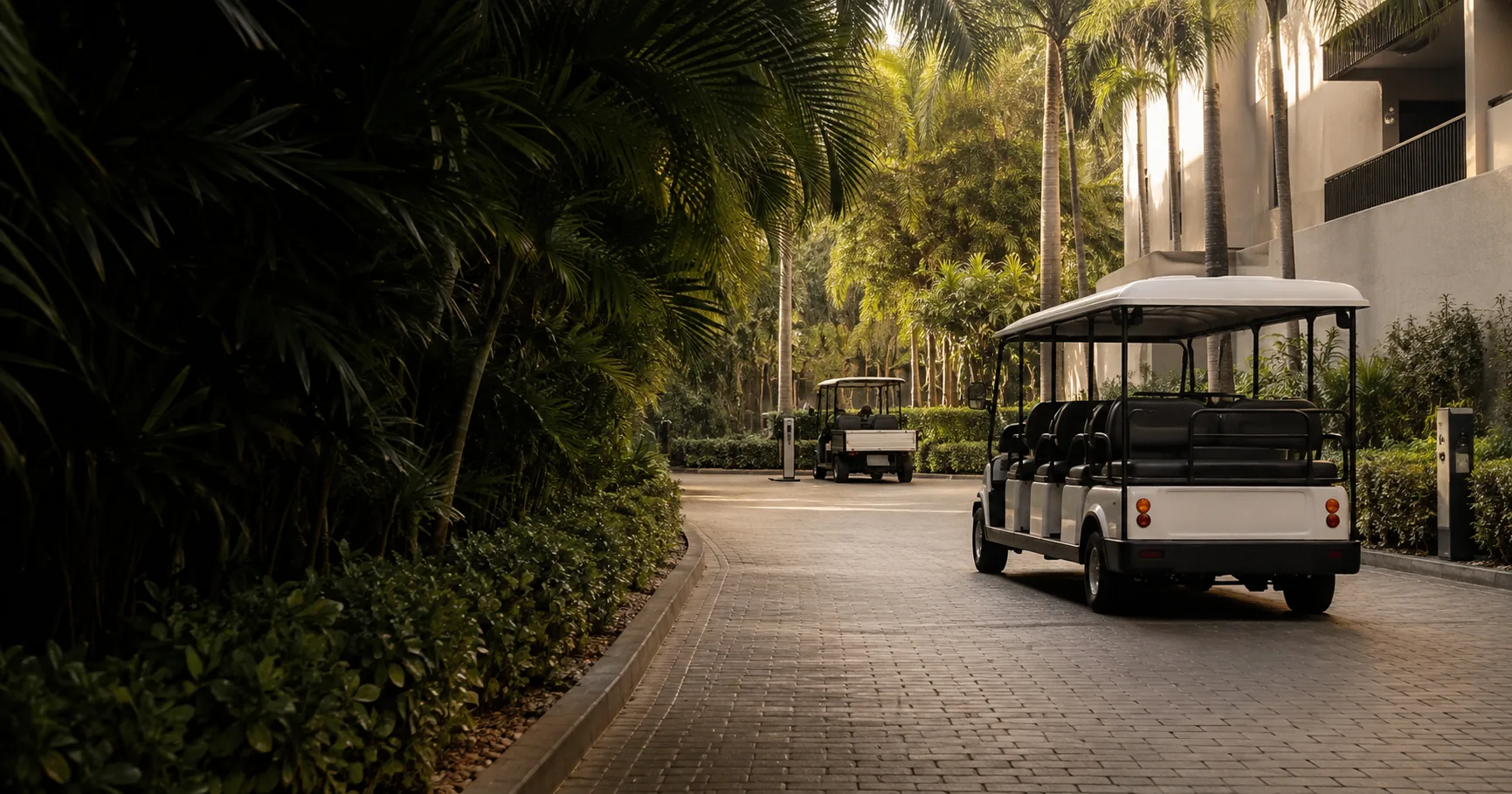
When evaluating passenger shuttle fleets for hospitality resorts, university campuses, and commercial venues, procurement directors must weigh initial capital cost against 5-year operating expenditures. Compare capital acquisition, energy consumption under load, battery cycling, tire scrub, and driver labor costs between 4-seat forward-facing and 6-seat electric shuttles.
Capital Expenditure (CapEx) vs. Seating Density
The baseline manufacturing architecture differs fundamentally between these two vehicle categories:
The 4-Seat Forward-Facing Model features a compact ladder frame with a 1,670 mm wheelbase and an overall vehicle length of 2,950 mm. All four passengers face forward, eliminating the motion sickness commonly experienced in rear-facing flip-flop seat kits. Curb weight is approximately 680 kg, powered by a 5 kW AC motor and 51.2V 105Ah LiFePO4 battery pack (5.37 kWh).
The 6-Seat Extended Shuttle utilizes an extended heavy-duty welded Q235 steel frame with an elongated 2,450 mm wheelbase and an overall vehicle length of 3,700 mm. Curb weight increases to approximately 840 kg, powered by a 5 kW AC motor with recalibrated low-end differential gearing and an enlarged 51.2V 150Ah LiFePO4 pack (7.68 kWh).
| Procurement Variable | Option A: Ten (10) 4-Seat Carts | Option B: Seven (7) 6-Seat Carts | Commercial Impact |
|---|---|---|---|
| Total Passenger Seats | 40 seats (10 vehicles × 4 seats) | 42 seats (7 vehicles × 6 seats) | Option B delivers +2 seat capacity |
| Average Unit Wholesale Price | ~$5,800 – $6,400 (FOB container) | ~$7,200 – $7,900 (FOB container) | Scaled factory volume pricing |
| Total Initial Fleet CapEx | ~$61,000 | ~$52,500 | Option B achieves ~$8,500 initial savings |
| Ocean Shipping Efficiency | Requires ~1.5 × 40HQ Containers | Fits tightly in 1 × 40HQ Container | Option B reduces inbound freight by ~$3,500 |
| Net Delivered Initial Cost | ~$67,000 | ~$55,000 | CapEx advantage: 6-Seat Option (~$12,000) |
Powertrain Duty Cycles & Electrical Operating Costs
While the 6-seat configuration saves on initial capital expenditure, operating energy dynamics depend on vehicle weight and frequency of transit:
- 4-Seat Unit: Consumes approximately 4.8 kWh to 5.2 kWh per 100 km under standard operating resort conditions (frequent stops, moderate luggage payload, flat to 5% grade).
- 6-Seat Unit: Due to higher rolling resistance, heavier curb chassis weight (+160 kg), and greater aerodynamic drag, energy consumption rises to 7.1 kWh to 7.8 kWh per 100 km.
Assuming an average commercial duty cycle of 40 km (25 miles) per vehicle per day at a commercial utility rate of $0.16 / kWh:
- 10-Unit 4-Seat Fleet: Annual power consumption of 7,300 kWh = $1,168 per year ($5,840 over 5 years).
- 7-Unit 6-Seat Fleet: Annual power consumption of 7,562 kWh = $1,210 per year ($6,050 over 5 years).
- Energy Variance: Over 5 years, electrical operational cost differences are negligible (< $250 variance). High-efficiency AC brushless motors and modern lithium BMS keep raw electricity overhead remarkably low across both platforms.
Routine Maintenance & Wear-and-Tear (OpEx)
Where operating expenditures diverge significantly is in mechanical component wear driven by axle load and chassis dimensions:
| Component Category | 4-Seat Fleet (10 Units) | 6-Seat Fleet (7 Units) | Wear Mechanism Analysis |
|---|---|---|---|
| Tire Replacement Cadence | Every 24 Months (~$3,600 over 5 yrs) | Every 14–18 Months (~$3,780 over 5 yrs) | Heavier rear axle scrub on 6-seat models accelerates drive-tire shoulder wear. |
| Brake Friction Materials | 15,000 km Service Interval (~$1,800) | 10,000 km Service Interval (~$2,450) | Higher kinetic energy dissipated during downhill stops with 6 adult passengers. |
| Suspension Bushings | Standard single-leaf maintenance (~$1,200) | Heavy multi-leaf + damper audits (~$2,100) | Elongated chassis incurs higher torsional flex over uneven path crossings. |
Operational Labor & Route Throughput
In resort and municipal campus operations, driver labor is the single largest operating expense if vehicles are not operated as guest self-drive rentals:
Dedicated Driver Scenario (Staffed Shuttle Service)
If the fleet operates on scheduled resort loops with dedicated employee drivers at an average loaded wage of $22.00/hour:
- Staffing 10 Carts (8 hours/day, 365 days): 29,200 labor hours = $642,400 annually.
- Staffing 7 Carts (8 hours/day, 365 days): 20,440 labor hours = $449,680 annually.
- Labor Savings: Deploying the 6-seat shuttle configuration saves over $190,000 per year in driver wages alone. Wherever dedicated staff drivers are provided, consolidating passenger volume into 6-seat shuttles is overwhelmingly the superior financial choice.
Guest Self-Drive & On-Demand Dispatch Scenario
Conversely, in master-planned communities, luxury rental villas, and golf resort rentals where guests drive themselves, 10 individual 4-seat carts provide 43% greater dispatch availability. Guests rarely travel in groups larger than 3 or 4; operating 6-seat vehicles with only 2 passengers creates empty-seat waste and increases path congestion.
Comprehensive 5-Year Total Cost of Ownership (TCO) Matrix
Combining all mechanical, utility, and capital variables for a 40-seat commercial passenger operation:
| TCO Cost Component | Option A: Ten (10) 4-Seat Shuttles | Option B: Seven (7) 6-Seat Shuttles | Advantage Analysis |
|---|---|---|---|
| Initial Delivered Fleet Cost (CapEx) | $67,000 | $55,000 | Option B saves $12,000 (-18%) |
| 5-Year Electrical Utility Expense | $5,840 | $6,050 | Comparable (Within 3%) |
| 5-Year Routine Parts & Maintenance | $6,600 | $8,330 | Option A saves $1,730 |
| 5-Year Battery System Degradation | $0 (Protected by 5-Yr LiFePO4 Warranty) | $0 (Protected by 5-Yr LiFePO4 Warranty) | 3,000+ Cycle Life on both |
| Subtotal TCO (Self-Drive / No Drivers) | $79,440 | $69,380 | Option B saves $10,060 over 5 years |
| 5-Year Staffed Driver Labor (If Applicable) | $3,212,000 | $2,248,400 | Option B saves $963,600 in labor |
Property Topology & Operational Decision Guide
Beyond financials, your physical resort or campus environment must dictate model selection:
- Choose the 4-Seat Forward-Facing Model if: Your property features narrow winding garden pathways, elevator access corridors, or tight turnaround pads (turning radius of 3.0 m). Individual guest party sizes average 2–4 persons, or carts are parked in standard storage bays under 3.0 meters in depth.
- Choose the 6-Seat Commercial Shuttle if: You operate scheduled fixed-route guest shuttle loops between central facilities, lobbies, and detached beach villas. Luggage transport is mandatory (rear seat fold-down cargo platform accommodates up to 4 oversized suitcases), or you maintain dedicated staff drivers.
Review commercial model specifications and fleet allocations: 4-Seat Commercial Fleet Model, 6-Seat Commercial Fleet Shuttle, Wholesale fleet container programs, Request a fleet TCO quote