
STATE REGULATIONS & SOURCING
California Street Legal Golf Cart & LSV Guide: DMV Registration, 25 MPH Road Rules & U.S. Stock Sourcing
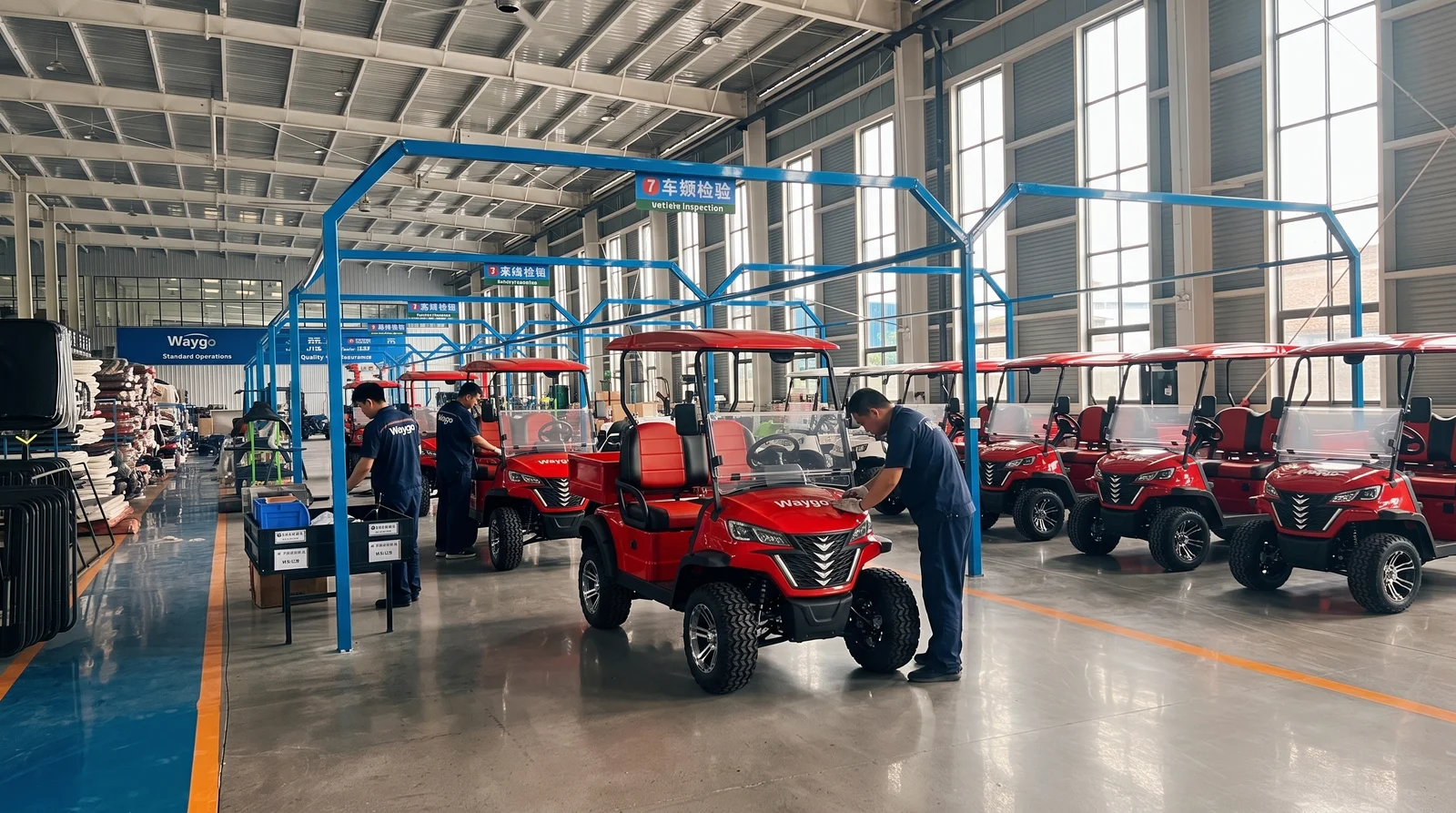
Operating an electric golf cart on California public roadways requires strict compliance with the California Vehicle Code (CVC) and DMV titling procedures. Understand the legal boundary between CVC § 345 golf carts and CVC § 385.5 Low-Speed Vehicles, review required DMV registration documentation, and evaluate two-track sourcing options from California partner warehouse stock.
The Legal Framework: Golf Carts vs. Low-Speed Vehicles in California
The California Vehicle Code maintains distinct statutory definitions and operational constraints across light electric vehicle classes:
Standard Golf Cart (CVC § 345)
Under CVC § 345, a “golf cart” is a motor vehicle having not less than three wheels in contact with the ground, having an unladen weight less than 1,300 lbs (590 kg), and designed to carry golf equipment and not more than two persons, operating at speeds not exceeding 15 to 19 mph.
Roadway Restriction (CVC § 21115 & § 21716): Standard golf carts may only be operated on public streets that are within one mile of a golf course, or on roadways explicitly designated for golf cart use by a local municipality under an approved Golf Cart Transportation Plan (GCTP). They cannot be driven on ordinary city streets.
Low-Speed Vehicle / LSV (CVC § 385.5 & § 21250–21266)
Under CVC § 385.5, a Low-Speed Vehicle (often marketed as a Neighborhood Electric Vehicle or NEV) is a 4-wheeled motor vehicle whose top speed is greater than 20 mph but not more than 25 mph, meeting all requirements of NHTSA Federal Motor Vehicle Safety Standard 500 (49 CFR § 571.500).
- Permitted Roadway Operation (CVC § 21260): Certified LSVs are legally permitted to operate on any public roadway where the posted speed limit is 35 mph (56 km/h) or lower.
- Crossing Higher-Speed Thoroughfares (CVC § 21262): An LSV driver may cross an intersection over a highway or street with a posted speed limit exceeding 35 mph if the intersection is controlled by an official traffic signal or stop signs.
California DMV Titling & Registration Workflow
To drive legally on California secondary roads, every LSV must obtain an official California certificate of title, standard automotive license plates, and a DMV registration card:
Required Documentation Checklist for Commercial Buyers:
- Manufacturer’s Certificate of Origin (MCO / COO): Issued directly by the manufacturer (Waygo), stating that the vehicle complies with all applicable Federal Motor Vehicle Safety Standards (FMVSS 500).
- Form REG 343 (Application for Title or Registration): Completed by the purchasing individual or corporate fleet entity.
- 17-Digit ISO 3779 VIN Verification: Physical inspection by a California DMV official or authorized VIN verifier confirming that the chassis-stamped VIN matches documentation and conforms to federal structure.
- Smog Exemption Verification: Pure battery-electric vehicles are 100% exempt from California smog inspections, but must be designated as electric (Motive Power: “E”) on registration records.
- Auto Insurance Policy: California Insurance Code § 11580.1b requires standard motor vehicle liability insurance coverage ($15,000 bodily injury per person, $30,000 per accident, and $5,000 property damage). Golf cart insurance riders do not satisfy California road legal requirements.
Mandatory Safety Equipment Mandated by California Highway Patrol (CHP)
The California Highway Patrol enforces strict adherence to FMVSS 500 equipment. If any of the following items are absent or non-functional, the vehicle will fail DMV inspection:
| System Mandate | California & Federal Benchmark | Waygo Commercial Build Standard |
|---|---|---|
| Windshield Glass | AS-4 or AS-5 DOT-certified automotive laminated safety glass. Acrylic screens are strictly prohibited on California roadways. | Integrated DOT-stamped curved laminated glass windshield with zero optical distortion. |
| Windshield Wiper | Electric motor-driven wiper clearing line of sight. | Heavy-duty electric wiper motor with integrated park position. |
| Braking Systems | Service brake stopping within 25 ft at 20 mph, plus independent mechanical parking brake holding 20% grade. | Four-wheel hydraulic braking (front disc / rear drum) paired with an independent mechanical floor-lock parking brake. |
| Occupant Restraints | 3-point lap-and-shoulder belts complying with FMVSS 209 at all seating locations. | Factory-integrated 3-point retractable seat belts on 2, 4, and 6-passenger configurations. |
| Lighting Suite | DOT/SAE-compliant high/low beam headlamps, front amber turn signals, rear red tail/brake lamps, and rear turn signals. | Automotive LED optical matrix lighting with dashboard turn-signal indicator and mechanical self-canceling stalk. |
| Mirrors | Driver exterior side mirror plus passenger exterior mirror or wide-angle rearview mirror. | Dual folding exterior side-view mirrors with integrated LED turn signals plus interior convex rearview mirror. |
| Acoustic Warning | Forward-facing warning horn and audible reverse motion alert. | High-decibel automotive horn and mandatory reverse beeper for pedestrian awareness in crowded zones. |
Key Municipal Golf Cart Transportation Zones in California
Beyond standard LSV road rules, several California municipalities have enacted formal Golf Cart Transportation Plans (GCTPs) pursuant to CVC Article 3:
- Palm Desert & Coachella Valley: Operates the most extensive cart transit network in the nation. Both certified LSVs and approved golf carts equipped with local permits can navigate designated golf cart lanes alongside primary arteries including Fred Waring Drive and Monterey Avenue.
- La Quinta & Rancho Mirage: Permitted carts can transit multi-use neighborhood paths connecting gated developments to commercial shopping plazas.
- Catalina Island (Avalon): Due to severe vehicle restrictions, electric golf carts and LSVs are the primary transit mode for residents and commercial businesses, governed by city-specific permit quotas.
- Roseville & Lincoln: Specific northern California master-planned developments feature dedicated grade-separated neighborhood electric vehicle (NEV) lanes.
Two-Track Procurement Strategy for California Commercial Buyers
Commercial fleet operators, golf clubs, property management companies, and regional dealerships in California operate under two distinct purchasing scenarios:
| Procurement Variable | Track 1: Immediate California Stock | Track 2: Scheduled 40HQ Fleet Container |
|---|---|---|
| Best Suited For | Sample evaluation, rapid replacement, small fleet lots | Volume fleet replacement, resort expansion, dealer inventory |
| Minimum Order Quantity | Single Units (1 unit minimum) | 1 × 40HQ Ocean Container (12–18 units) |
| Delivery Lead Time | 2 to 5 Business Days | 35 to 45 Days (Ocean Freight) |
| Fulfillment Location | California Partner Warehouse | Direct Port of Oakland / Los Angeles / Long Beach |
| Pricing Structure | Local wholesale stock pricing | Maximum tier FOB container volume pricing |
Waygo Corporate Presence & California Support Infrastructure
Waygo bridges the gap between overseas factory pricing and domestic commercial accountability:
- Domestic Corporate Entity: Registered in Sacramento, California, Waygo Golf Cart Inc. provides institutional purchasers with domestic contracting, compliant U.S. invoicing, and direct access to factory representatives.
- Parts & Technical Depot: Wear items—including brake pads, controller components, optical light clusters, and DOT windshield glass—are stocked domestically to prevent fleet downtime.
- Verified Factory Powertrains: Every vehicle features a high-performance 5 kW AC induction motor and automotive-grade 51.2V LiFePO4 lithium battery pack (105Ah on 2-seat and 4-seat models; 150Ah on 6-seat shuttles), engineered to deliver dependable 25 mph cruising and 40+ miles of range per charge on California roads.
Learn more about California stock and wholesale programs: California dealer and stock portal, Wholesale electric golf carts, 6-seat commercial shuttles, Request California availability