
SAFETY & COMPLIANCE
Commercial LSV Safety Standards: DOT (FMVSS 500), ANSI B71.9 & UL Battery Compliance for U.S. Fleets
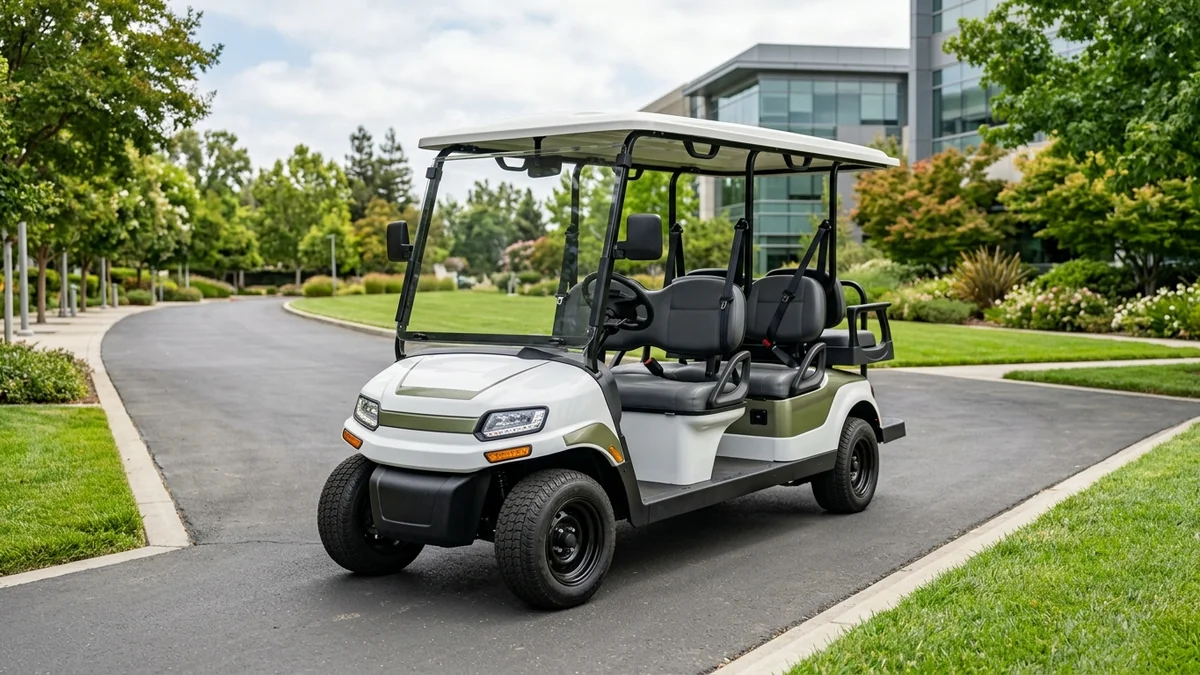
When procuring electric low-speed vehicles (LSVs) and passenger shuttles for commercial campuses, master-planned developments, or resort properties, fleet directors must comply with federal safety standards and state road mandates. Compare FMVSS 500 equipment rules, ANSI B71.9 dynamic stability testing, and UL lithium battery certifications, then explore Waygo commercial compliance packages for U.S. dealer and fleet operations.
Federal Motor Vehicle Safety Standards: The FMVSS 500 Legal Suite
Under Title 49 of the United States Code of Federal Regulations, an electric low-speed vehicle is defined as a 4-wheeled motor vehicle whose top speed attainable in 1 mile is greater than 20 mph (32 km/h) and not more than 25 mph (40 km/h) on a paved level surface, with a Gross Vehicle Weight Rating (GVWR) under 3,000 lbs (1,361 kg).
To achieve legal street classification, the vehicle must incorporate 10 factory-integrated components certified under complementary FMVSS sub-parts:
| Component Mandate | Statutory Specification | Engineering Benchmark & Factory Execution |
|---|---|---|
| Windshield Assembly | FMVSS 205 (49 CFR § 571.205) / ANSI Z26.1 | Must utilize automotive-grade laminated safety glass rated AS-1, AS-4, or AS-5. Foldable acrylic or polycarbonate windscreens commonly found on golf carts fail this federal standard due to shatter risk and lack of wiper abrasion resistance. |
| Windshield Wiper System | FMVSS 104 (49 CFR § 571.104) | Electric motor-driven wiper arm with continuous cycle sweep clearing the driver’s primary line of sight. |
| Occupant Restraints | FMVSS 209 (49 CFR § 571.209) & FMVSS 210 | Three-point automotive lap-and-shoulder seat belts at all designated seating positions. Anchorages must withstand a static pull load of 3,000 lbs per occupant without structural bulkhead tear-out. |
| Headlamps & Optics | FMVSS 108 (49 CFR § 571.108) | Dual automotive-grade headlamps providing both high- and low-beam luminous distribution with standardized photometrics to illuminate 150 feet of road grade. |
| Signaling & Turn Indicators | FMVSS 108 | Front amber and rear red turn signal lamps paired with an in-cabin mechanical canceling switch and audible/visual dashboard flasher indicators. |
| Tail & Stop Lamps | FMVSS 108 | Dual rear red stop lamps triggered instantaneously by brake pedal displacement, visible from a minimum distance of 500 feet in daylight. |
| Reflex Reflectors | FMVSS 108 | One amber reflector on each side near the front, one red reflector on each side near the rear, and two red reflex reflectors positioned symmetrically on the rear fascia. |
| Rearview Mirrors | FMVSS 111 (49 CFR § 571.111) | An exterior mirror mounted on the driver’s side combined with either an exterior mirror on the passenger’s side or an interior overhead wide-angle mirror. |
| Parking Brake System | FMVSS 500 § 571.500(b)(7) | Mechanical locking brake mechanism capable of holding the fully laden vehicle static on a 20% incline under both dry and wet surface conditions. |
| Vehicle Identification Number | 49 CFR Part 565 | A permanent 17-digit ISO 3779-compliant VIN stamped directly into the welded tubular steel chassis and printed on a tamper-evident federal certification label. |
Dynamic Stability & Mechanical Stress Standards: ANSI B71.9
While FMVSS 500 governs road legality, institutional and resort operators navigating undulating golf facilities, campus roads, and mixed terrain require compliance with ANSI B71.9. This standard subjects the chassis, steering geometry, and braking system to severe dynamic load testing:
Service Brake Deceleration & Stopping Distance
Under ANSI B71.9 testing protocols, a commercial transport cart loaded to maximum GVWR must execute controlled, linear emergency stops without swerving outside a 12-foot lane width:
- Test Metric: Emergency brake actuation at maximum governed operating speed (25 mph / 40 km/h).
- Stopping Distance Threshold: Must achieve full vehicle standstill within 25 feet (7.62 meters) on clean, dry, level asphalt.
- Fade Resistance: Must maintain at least 80% stopping effectiveness following 10 consecutive high-speed stopping cycles.
- Waygo Engineering Execution: Standard four-wheel hydraulic braking systems featuring front disc brakes and heavy-duty rear drum units, paired with adjustable regenerative electric motor deceleration through the programmable AC motor controller.
Lateral Tilt & Static Rollover Stability
Vehicle center-of-gravity (CG) height directly impacts passenger safety during tight turns and hillside traversals. The vehicle is secured to a tilt platform loaded with 175-lb (80 kg) anthropomorphic test dummies at all seating positions:
- Standard Requirement: The vehicle must maintain ground contact on all four tires on an incline angle of at least 15 degrees (26.8% slope) without lifting its upper wheels.
- Chassis Rigidity: Waygo’s Q235 low-alloy high-strength welded steel ladder frame incorporates cross-member triangulation, placing the 51.2V lithium-ion battery pack below seat-level between the chassis rails to achieve a low roll center and superior lateral stability.
High-Voltage Electrical & Lithium Safety: UL 2580 & UL 2271
The commercial transport sector has decisively moved away from heavy, maintenance-intensive flooded lead-acid batteries in favor of Lithium Iron Phosphate (LiFePO4) chemistry. Institutional fleet buyers must verify compliance with two testing benchmarks:
UL 2271: Battery Enclosure Integrity for Light Electric Vehicles
- Vibration Endurance: Multi-axis high-frequency sinusoidal sweep testing to simulate 50,000 miles of operation over unpaved roads without weld separation or internal cell tab shearing.
- Water Ingress & Salt Fog: IP67 enclosure sealing ensuring zero electrolyte contamination or short-circuiting during torrential downpours or automated chassis wash-downs.
- Impact & Penetration Resistance: Steel drop-weight impact testing on the outer battery casing to verify that internal cells remain isolated during side-impact collisions.
UL 2580: Battery Cell Chemistry & Electrical Protection
- Thermal Runaway Containment: In the event of a single cell failure, the internal pack architecture must vent gases safely without initiating cascade propagation to adjacent cells.
- Cell Chemistry Selection: Waygo utilizes dedicated prismatic LiFePO4 cells offering an inherently stable thermal runaway threshold of 270°C (compared to 150°C for nickel-cobalt chemistries), guaranteeing over 3,000 charge cycles before capacity degrades to 80%.
- Redundant Solid-State BMS: Micro-controller software monitoring voltage down to the millivolt level, isolating the pack within 15 milliseconds of an over-voltage or thermal anomaly.
Technical Compliance Audit Matrix: Comparing Vehicle Classifications
Before issuing purchase orders, procurement managers should audit vendor technical specifications against the regulatory baseline below:
| Feature & Testing Parameter | Standard Campus Golf Cart | ANSI B71.9 Light Transport | Certified FMVSS 500 Low-Speed Vehicle |
|---|---|---|---|
| Typical Legal Classification | Off-road equipment | Industrial utility vehicle | Motor vehicle (Automotive Class) |
| Maximum Governed Speed | 12 – 14.9 mph (19 – 24 km/h) | 15 – 19.9 mph (24 – 32 km/h) | 20 – 25 mph (32 – 40 km/h) |
| Legal Roadway Operation | Private turf & paths only | Private facilities & gated plazas | Public streets with speed limits ≤ 35 mph |
| Chassis Identification | Internal serial tag | Industrial serial plate | 17-Digit ISO 3779 VIN |
| Title & Documentation | Commercial invoice | Manufacturer invoice | Federal MCO (Manufacturer’s Certificate of Origin) |
| Windshield Glass Standard | Acrylic fold-down (Impact non-rated) | Polycarbonate (Abrasion treated) | DOT-Certified AS-4/AS-5 Laminated Glass + Wiper |
| Braking Mechanism | Rear mechanical drums or motor brake | 2-wheel mechanical / hydraulic | 4-Wheel Hydraulic Disc/Drum + Mechanical Lock |
| Seat Belt Systems | Typically none (Optional 2-point) | 2-Point lap belts | FMVSS 209 Type 1 or Type 2 3-Point Restraints |
| Lighting Photometrics | Basic LED courtesy bars | Work lights & amber flashers | FMVSS 108 Certified High/Low Headlamps & Turn Signals |
Waygo Street-Legal Compliance & Dealer Support
As an integrated manufacturer of commercial low-speed electric vehicles, Waygo builds fleet assets on an automotive production line rather than modifying consumer golf carts after the fact:
- Factory-Integrated Street Legal Packages: Our Waygo U.S. dealer support team engineers FMVSS 500 lighting harnesses, automotive laminated glass, electronic wipers, and 3-point belt anchorages directly into chassis fabrication.
- Standardized High-Torque Powertrain: Every vehicle features a high-efficiency 5 kW AC induction motor paired with an automotive-grade 51.2V LiFePO4 lithium battery pack (105Ah on 2-seat and 4-seat models; 150Ah on 6-seat shuttles), ensuring effortless 25 mph cruising and 25% grade climbing capabilities.
- Factory Documentation Provided: Every street-legal unit ships with a verifiable 17-digit VIN stamped onto the frame neck, a tamper-proof Federal Certification Label, and a clean Manufacturer’s Certificate of Origin (MCO) ready for immediate submission to state DMVs.
- U.S. Corporate Presence & Parts Stock: Supported by Waygo Golf Cart Inc. in Sacramento, California, commercial fleet buyers have direct access to U.S. warehouse inventory for fast warranty replacement of DOT lighting, windshield assemblies, and controllers.
Explore our vehicle specifications and commercial programs: Wholesale commercial golf cart program, Authorized U.S. dealer network, 2-seat commercial models, 4-seat commercial models, 6-seat passenger shuttles